The Ajapa Japa that hums within the breath
Soham Sadhana
A Living Guide
Every moment, the breath flows by itself; the tradition of the sages teaches you to join So–Ham to it, silently, in the mind. A special living guide for serious seekers who want to recognise that rhythm rightly and, little by little, gather a scattered mind into focus.
When the time is up, the price becomes ₹499.
Get the Living GuideSo · Ham
Is this guide for you?
Soham is simply the natural flow of the breath. But if the right rhythm, the posture, the time to practise and the way back when the mind wanders are not clear, the experience can be slow to come. This guide fills that gap, step by step.
The Living Guide
What’s inside?
Soham is the breath’s own effortless play. Yet if you practise without knowing the right method, both the experience and its fruits can be slow to come. This guide was made for seekers who sincerely want two things: an open door to success in life, and ease on the spiritual path. You don’t need it to begin; but if you want to learn the right method through clear understanding rather than guesswork, it will serve you well. This ₹199 introductory offer is open to each visitor to Dhyan Marga only once; when the time is up, the regular price is ₹999.
DHYANMARGA · DAILY MEDITATION ROOM
Dhyan Marga — your daily meditation room
At home, at work or on the move — whether you have five minutes or thirty, you can return to this space at any time. Put on headphones if you have them, press start, and settle quietly into the natural So–Ham flow of the breath.
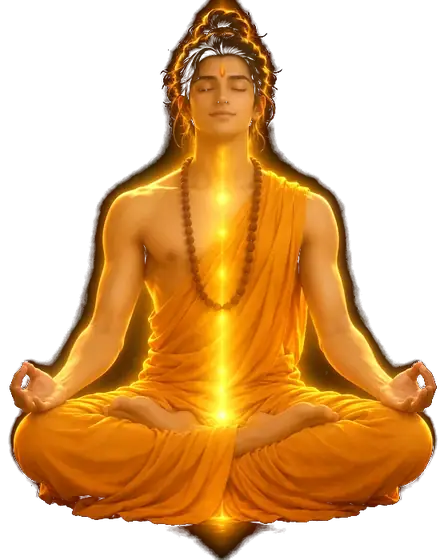
Think of the yogi seated on the screen as a symbol of your own quiet, true self. The more regularly you give him your time, the brighter his aura grows. Let that growing light remind you of your insight, your discipline and your peace: it is the glow of a lamp that has already begun to burn within you.
Even a short pause has value. On the days you want to go deep, sit undisturbed for at least thirty minutes and simply keep watching the breath, without reaching for results.
You can begin without the guide — so when does it help?
Soham practice begins with your own breath. For the first few days, simply practise in a relaxed way. Don’t push for experiences; neither draw the breath in by force nor hold it.
If the “So”–“Ham” rhythm, your posture, your timing, coming back when the mind wanders, or making sense of experiences that arise leave you unsure, the Living Guide gives you a clear, ordered explanation. It promises no results; it clears away the guesswork and helps you steady your practice — the fruit blossoms from the practice itself.
Traditions say that nature herself comes before us as the teacher — a poetic way of saying that if you watch the breath, the body and the silence with care, they teach you something every day. One hour is enough to meet this teacher: Brahma Muhurta, the wordless meeting point where night dissolves and day is born. Sages have chosen this hour for thousands of years; in its stillness, Soham deepens naturally with the breath.
Seven fortresses of light asleep in your spine — the secret map the ancient texts reveal
For thousands of years, sages kept a secret safe in the manuscripts of the scriptures: the human spine is not merely bone — it is a ladder of light with seven locks. The Shatchakra Nirupana and the Shiva Samhita declare, without hesitation, that as each lock opens, a new power awakens within a person. What follows is not our imagination — it is the texts’ own voice. Each stage has two parts: first, what the texts say; then, what it means for your life today.
- Whoever meditates on that power, radiant as ten million suns, at once becomes a master of speech and a king among men — the text calls him vachamisho narendrah
- He comes to delight in every branch of learning — according to the text, even what he never studied begins to open from within
- The text sings: his inner self overflows with boundless bliss
- The Shiva Samhita says: when the practice ripens, he rises above the ground; past, present and future — all three open before his eyes
When the roots are strong, fear begins to fade. Slowly, you can gain a hold on the restlessness you carry about money, home and security.
- All the inner enemies, ego among them, are destroyed in that very instant
- He becomes foremost among yogis, shining like the sun in the dense darkness of delusion
- Nectar-sweet words flow from his tongue as prose and poetry
- The Shiva Samhita says: he swallows death, rather than death swallowing him — and lofty powers such as anima and laghima come to him
The dryness stored up inside begins to clear. Joy returns to your work, and words start to flow of their own accord.
- Whoever meditates on this navel lotus gains full mastery over both dissolving and sustaining
- Saraswati, with all the riches of knowledge, dwells for ever on his tongue
- The Shiva Samhita says: he is able to make gold; with divine sight he beholds the perfected ones; he knows of treasure buried in the earth
- The Shiva Samhita goes on: he attains the siddhi of the underworld, becomes master of his desires, and outwits even death
Willpower awakens. Procrastination fades, you learn to say “no”, and the resolve to see your decisions through begins to grow.
- The text calls it the kalpavriksha, the wish-fulfilling tree that gives even more than is asked; within, where not even a breath of wind stirs, burns an unwavering light like the flame of a lamp — that is the hamsa
- The meditator becomes a lord of speech; like God himself, he becomes able to sustain and dissolve the world
- He gains the power to enter another’s body in an instant
- The Shiva Samhita says: knowledge of the three times, divine hearing, divine sight, and the power to roam the sky at will — both khechari and bhuchari
Old bitterness begins to fall away. Relationships mend, and a mind is born that accepts others just as they are.
- He becomes a poet, eloquent and wise — his mind attains supreme peace
- The text calls him trikalanam darshi — one who sees the three times with his own eyes
- The text sings that, beyond all sorrow, he shines like a swan
- The Shiva Samhita says: the four Vedas, with all their secrets, open before him in that very instant; when he rises from meditation, thousands of years feel like a single moment
You can say what is inside you exactly as it is — and your words begin to carry weight.
- He becomes sarvajnah sarvadarshi — all-knowing, all-seeing
- He becomes able to create, sustain and dissolve the three worlds
- Whoever steadies his life-breath here at the hour of death enters that eternal Being described in the Vedanta
- The Shiva Samhita says: all the fruits of the other five lotuses come from knowing this one chakra alone
An understanding that arrives before logic awakens — people, situations and the next step all begin to come clear.
- He is not born into this world again; nowhere in the three worlds is he bound
- He receives samagra shaktih — complete power, able to create and dissolve, abiding for ever
- There lies Shiva’s pure, eternal state — named Nityananda, eternal bliss, the very form of pure knowledge; some call it moksha
- The Shiva Samhita says: he uplifts thousands
Here the accounting of gain and loss falls away. To be wholly present in what is — that is all that remains.
The day all seven awaken together — the eight siddhis
Patanjali says it in a single sutra — tato’nimadi-pradurbhavah — then anima and the other powers appear of themselves. The names of all eight come from Vyasa’s commentary. The Shatchakra Nirupana goes further still, declaring that one who reaches that state is not born again, and that samagra shaktih — complete power, able to create and dissolve — abides steadily within him. This is what the texts call jivanmukti: freedom while still alive.
- Anima — becoming as subtle as an atom
- Laghima — becoming as light as cotton
- Mahima — expanding without limit into vastness
- Prapti — reaching whatever one wishes without leaving one’s place
- Prakamya — the mind’s resolve coming true
- Vashitva — mastery over all beings
- Ishitva — sovereignty and splendour; becoming master wherever one stands
- Yatrakamavasayitva — resolve fulfilled anywhere, without obstacle
And here is something remarkable: the very texts that describe these siddhis so brilliantly warn about them in the next breath. Patanjali’s Yoga Sutras 3.37 says these powers are obstacles to samadhi; only to the outward-turned mind do they look like achievements. The Yoga Tattva Upanishad 75–76 says the same: siddhis are a great hindrance on the way to yoga — take no delight in them. So the two greatest enemies here are haste and ego; tradition says the path opens for the one who does not make attainment the goal.
The Hamsa Upanishad and the Dhyanabindu Upanishad (61b–63) give the same count: by their reckoning there are 21,600 breaths in one day and night — and tradition counts every breath as one japa: “So” with the incoming breath, “Ham” with the outgoing. This is called Ajapa Gayatri — the japa that goes on without being recited. The texts declare that no knowledge, no japa and no merit equals it — none ever has, and none ever will. More remarkable still, it is the Hamsa Upanishad itself that gives the order of ascent through the seven chakras: raising the air from Muladhara, circling Svadhishthana three times, passing through Manipura and Anahata, steadying the prana in Vishuddha, then Ajna, and at last the brahmarandhra. In other words, the ladder you were searching for need not be built anew — it already stands upright within your breath.
The conduct of a seeker of light
- Whether you are a woman or a man, the foundation is the same: clean food, enough sleep, honesty, a regular routine and respect for the body’s limits.
- If pornography, unchecked sexual arousal, masturbation or any other habit that has become a compulsion scatters your mind, do not hate yourself. Recognise the pull, step away from that setting, return to a few gentle breaths — and, if you need it, ask a trusted counsellor for help.
- An unwanted or wrong thought arising is not a defeat. Coming back to the breath — without fighting the thought, without turning it into action — that is the practice.
- Don’t rush to magnify private experiences such as light, trembling, dreams or deep peace. Traditions advise humility, and keeping them to yourself for a while; don’t seek praise by displaying miracles.
- Mastery over desire, anger, greed, envy, food and sleep doesn’t come overnight. Steady awareness builds a healthy relationship with them — not suppression, and not self-punishment.
A path of breath beyond religion, caste or gender
In the 21-day Brahma Muhurta guide, Shiva’s meditating form appears only as a symbol of the Adiyogi and Mahayogi — the first and the great yogi; no worship or conversion is required. The Buddha, Mahavira, Guru Nanak, Jesus and many wisdom traditions remind us of peace, compassion and turning inward. None of their names is used as proof of any sales promise.
This breathing practice is open to everyone — Hindu, Muslim, Sikh, Christian, Buddhist, Jain, followers of any other tradition, or of none at all. Everyone breathes; this is the door we all share.
Let depth come slowly — safety first
Traditions describe experiences such as light, warmth, trembling or expansion in poetic language. Not everyone has them; if you don’t, nothing is missing from your practice — the texts say one thing only: do not chase experiences. If you feel uncomfortable at any time, stop right there; feel your feet on the ground, breathe naturally and sit quietly. Practice is not a battle fought against the body — it is a surrender.
Never force the breath. Balanced food, enough water, unhurried sleep — this is the routine the texts describe. In the early days, sitting for a short while is enough: five minutes in Brahma Muhurta, simply listening to the breath, is a beginning. Your practice grows at the pace your body becomes ready. During pregnancy, choose an even gentler course; if you are unwell or taking medication, increase your practice only on your doctor’s advice.
You can write to us with your question while keeping your privacy safe. We will offer practical guidance wherever we can. Write about any doubt connected with your practice; in any emergency, please first speak to someone near you.
[email protected]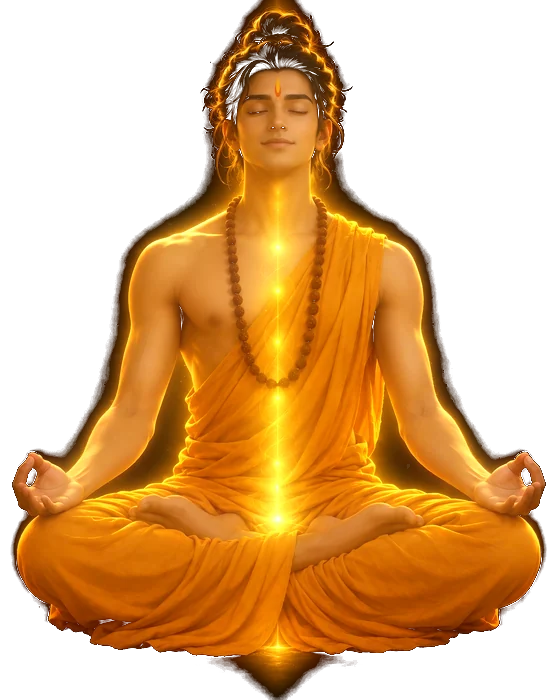
Dhyan Marga Publications
Soham Sadhana
Every moment, the breath flows by itself; the tradition of the sages teaches you to join So–Ham to it, silently, in the mind. A special living guide for serious seekers who want to recognise that rhythm rightly and, little by little, gather a scattered mind into focus.

Completely free
Came looking for something free? A divine meditation room is waiting for you
Dhyan Marga offers people of every age, every background, every walk of life — young and old alike — a private, divine meditation room, completely free and open whenever you wish. In it, you do not simply follow the breath in and out; you watch your seven chakras awaken, and the whole universe melt and merge within you. The first chakra appears to awaken within about 170 breaths — and the longer you sit, the more chakras open.
👧👦 Let your children sit with you too
Whatever feels easy each day — 10 to 30 minutes, and one day a week, if they wish, a little longer. Children get to practise focusing, they connect with nature — and, little by little, their minds can learn to stay calm even through the tangles and setbacks that life will bring.
The effect of regular practice usually shows itself slowly — and often the people around you notice the change first; you may not even realise it yourself.
🎧 Best with headphones or earphones — they bring out the subtle layers of the sound; without them, you can still step inside.
🎧 Enter the free meditation roomThe room is free. Right now, this guide is yours for ₹199 — its introductory price — after that, the same guide will cost ₹999 instead. So why not today?