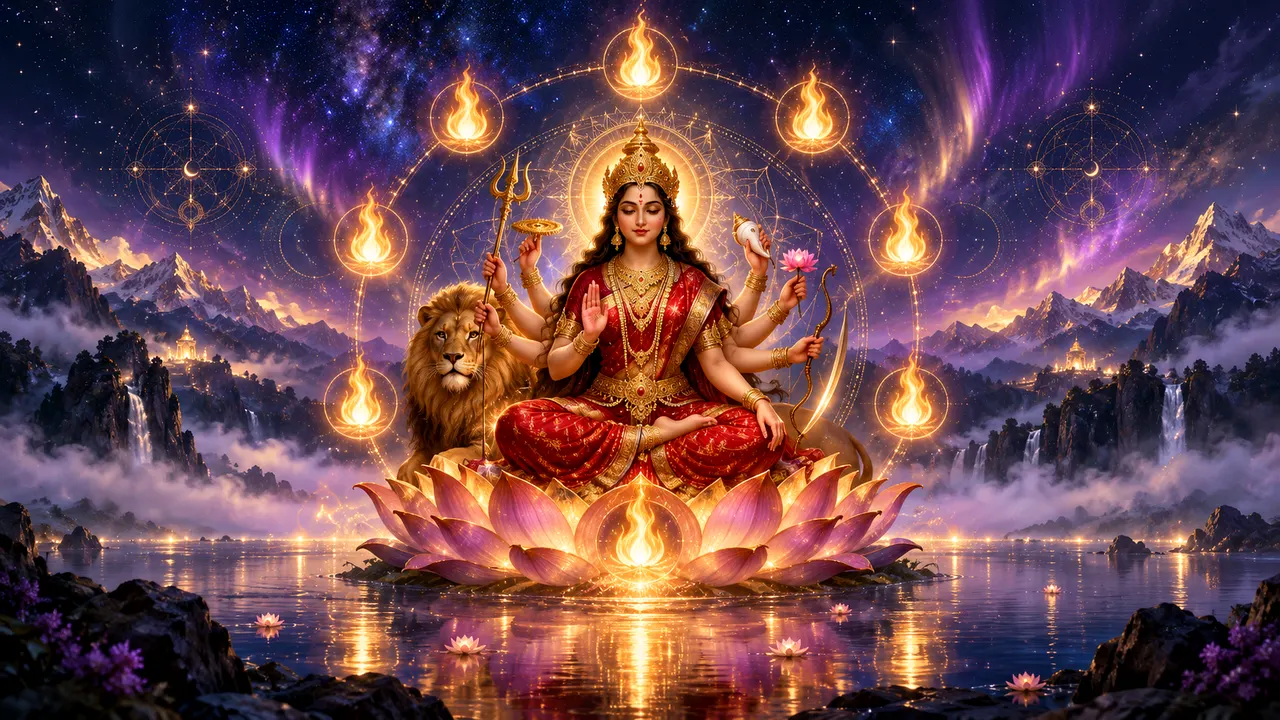
🎵 देवी सूक्तम् (ऋग्वेद 10.125) — वेदाध्ययन गोष्ठी · Devi Suktam, Rigveda

✦ From Dhyan Marga ✦
The Navratri Sadhana Guide · nine nights, nine faces of the Divine Mother · one sacred flame of intention
For nine nights each autumn, lamps are lit across India and hundreds of millions turn towards the Great Mother — as seekers have done for more than a thousand years. This year, walk with them: 25 quiet minutes before dawn, one face of the Goddess each night, her mantra on your lips and her flame before you — and discover what awakens in you.
🪔 Sharad Navratri 2026 begins Sunday 11 October and ends with Vijayadashami on 20 October (Indian dates — please check the timing for your local time zone)
Secure checkout on Topmate, shown in your currency · discount-code field at checkout
One-time price · instant access · works on your phone, even offline

Shailaputri means «daughter of the mountain». Born to Himavan, king of the Himalaya, she is Sati reborn as Parvati, who found her way back to Shiva. She rides Nandi the bull, holds a trident and a lotus, and wears a crescent moon in her hair; her colour is red. Inwardly she is the first step of every sadhana (spiritual practice): a foundation as steady as a mountain, from which every other power can rise.
Brahmacharini is «she who walks in Brahman» — the Goddess as the ascetic. Barefoot and dressed in white, she holds a rosary (mala) in one hand and a water pot (kamandalu) in the other. Tradition tells that Parvati performed tapas — fierce inner discipline — for thousands of years to win Shiva, living on leaves and then on nothing at all. She is the fire of one-pointed devotion that burns in every sincere seeker.
Chandraghanta wears on her forehead a half-moon shaped like a temple bell (ghanta). Golden, ten-armed and riding a lion, she carries weapons, yet her face is serene. Tradition says the sound of her bell drives away demons and every dark force. She is Parvati as the bride of Shiva — ready for battle and full of grace at once: courage that is calm, a warrior who is at peace.
Kushmanda is the Goddess who, tradition says, created the universe with her smile. When there was only darkness, her gentle laughter gave birth to the cosmic egg (brahmanda) — and so her name joins «ku» (a little), «ushma» (warmth) and «anda» (egg). Eight-armed and riding a lion, she is said to dwell in the very heart of the sun. She is the radiant, life-giving energy that makes everything bloom.
Skandamata is the mother of Skanda (Kartikeya), the young commander of the army of the gods. She sits on a lotus or on a lion, holding her child on her lap; two hands carry lotuses and one is raised in blessing. Her mood is pure tenderness. Tradition says that whoever worships her receives the grace of both mother and son. She is the love that protects and the wisdom that raises a hero.
Katyayani was born, tradition says, in the hermitage of the sage Katyayana, who longed for the Goddess as his daughter. When the buffalo-demon Mahishasura terrorised the worlds, the combined fire of the gods took form in her, and she destroyed him. Riding a lion, sword in hand, she is the warrior Mother. In the Bhagavata Purana the young gopis (cowherd girls) of Vrindavan kept a month-long vow to her, praying for Krishna as their husband.
Kalaratri, «the night of time», is the most fearsome form of the Mother — dark as a storm cloud, hair unbound, breathing fire, riding a donkey. One hand holds a cleaver, another a torch, while two hands bless and grant fearlessness. Yet she is also called Shubhankari, «she who does good». She destroys darkness itself; in her terrifying beauty the seeker discovers that nothing is left to fear.
Mahagauri means «the great radiant white one». Tradition says Parvati’s skin had darkened during her long tapas, and Shiva bathed her in the waters of the Ganga until she shone like the moon, a conch and jasmine. Dressed in white and riding a white bull, she holds a trident and a damaru drum. She is purity, forgiveness and the calm after the storm. On the eighth night (Ashtami) many families honour young girls as her living form.
Siddhidatri is «the giver of siddhis» — perfections and spiritual powers. Seated on a lotus, four-armed, holding a discus, a conch, a mace and a lotus, she is worshipped by gods, sages and seekers alike. Tradition says even Shiva received his siddhis by her grace and became Ardhanarishvara — half Shiva, half Shakti. On the ninth night (Navami) she completes the journey: everything sought in the eight nights comes together in her.
Tap a lamp and the Goddess of that night appears in its flame. Tonight’s lamp lights itself, counted from the day you set your intention.
Hear the night’s mantra or a deep Om with one tap — the mantra changes by itself every night.
Tap any story, symbol, mudra or ritual and a clear explanation opens — written for people who meet these traditions for the first time.
Eight study cards: the Rigveda’s Devi Sukta, the Kena and Devi Upanishads, the Durga Saptashati, the Devi Bhagavata, Adi Shankara’s Saundarya Lahari and the Devi Gita.
A simple altar from what you already have, or a full traditional one if you can source the items — with Western substitutes.
Sign your intention with your finger, track each night privately, use it without internet, print it as a PDF.
For each night: the Goddess and the meaning of her symbols, her ancient meditation verse with translation, a short name-mantra, a mudra, a simple water ritual, a guided visualisation, a seal phrase and a morning affirmation.
Seven sacred mantras — including the Navarna mantra of the Goddess and the beloved hymns of the Durga Saptashati — with pronunciation, breath, meaning and a bead counter. Tap to hear the mantra or a deep Om.
Five gentle practices to prepare your space — sacred recitation, evening aarti, the sunrise–sunset lamp, sacred water, cleaning with intention — with substitutes for what you can find outside India.
Tick each night, record your mantra count and one line of experience — your streak stays private on your device.
Choose or write one intention for the nine nights and sign it with your finger. Read it each night before you sit.
After the mantra, 5–10 minutes of guided Soham («I am That») breath meditation on dhyanmarga.com — linked inside the guide.
Navratri — literally «nine nights» — is India’s great festival of Shakti, the creative power of the universe worshipped as the Divine Mother. In her nine forms she has been asked for steadiness in an unsteady life, focus, courage in the face of fear, warmth and abundance, love in the family, the clearing of obstacles, release from the darkness of the past, purity of heart, and finally a deep trust in which peace replaces worry. This guide gives you that ancient sequence as a simple, sincere nightly practice — whatever your background.
We don’t sell miracles, powers or guarantees. We offer a path that has been walked for centuries — the walking is yours, the grace is the Mother’s.
ॐ देवी शैलपुत्र्यै नमः · Om Devī Śailaputryai Namaḥ
“My roots are deep. My intention is unshakable. Ma Shailaputri is with me.”
Mudra: Prithvi (earth) mudra · Water ritual: a pinch of rock salt · Visualisation: you, seated unshaken on a Himalayan peak beneath the stars…
Spiritual curiosity scattered across books and apps
➜Many find one living practice, held faithfully for nine nights
Power understood as control or effort
➜Shakti felt as a sacred, receptive and creative force
Fear and the past quietly in charge
➜Fear seen, named and met — the past a little lighter
The Goddess as an idea or a symbol
➜The Goddess as a presence you sit with each night
Practice as self-improvement
➜Practice as offering, devotion and trust
On the ninth night the journey reaches Siddhidatri, «she who grants siddhis». The scriptures describe eight great siddhis, the aṣṭa-siddhi: aṇimā (becoming as small as an atom), mahimā (becoming vast), garimā (immovable weight), laghimā (weightlessness), prāpti (reaching anywhere), prākāmya (fulfilment of will), īśitva (lordship) and vaśitva (mastery over all). Yet Patanjali’s Yoga Sutras warn that such powers can become obstacles. So the teachers turn them inward: anima is humility, mahima a heart vast enough for all, garima a steadiness no storm can move, laghima freedom from every burden, prapti reaching others with love, prakamya a will in tune with the Divine, ishitva mastery of oneself, vashitva calm over the senses. This, tradition says, is the siddhi the Mother truly reveals — the one power no one can take away.
Inside you will find two ways to set up your altar: a simple one using what you already have at home (a candle or tea-light, a flower, a glass of water), and a full traditional one if you can source the items. Both are complete. The Mother looks at your bhava — the feeling in your heart — not at what you spend.
The Divine Mother belongs to all her children. There is no barrier of religion, gender, background or country here, and no initiation is needed for the practices in this guide. If your own tradition has customs — for example around practice during menstruation — follow them; many women choose to practise inwardly at such times, with silent mantra and visualisation, and inner worship is complete worship. Sincerity is the only qualification.
One designed guide holds everything: the nine nights, the mantra sheet with sound, the nine lamps, the scripture study cards, the home sanctuary practices, the tracker and your sankalpa. Tick nights on your phone, read on your laptop, or save it as a PDF and print it. Once opened, it works without internet.
Yes. The Goddess is honoured as the Mother of all beings; there is no barrier of religion, country or background. Approach with respect and sincerity — that is all that is asked.
Whichever night you begin is your first night. You can also keep the nine nights at any time, and the guide works for both Navratris each year (spring and autumn).
Every verse has a transliteration and a simple meaning, and the mantras can be heard with one tap. Feeling matters more than perfect pronunciation.
Right after checkout, Topmate shows both «Read Online» and «Download» links and emails them to you.
No one can honestly promise that. The scriptures describe siddhis, but the teachers point to their inner meaning — humility, steadiness, lightness, mastery of oneself. That is what this practice cultivates.
No. It is a spiritual practice, not medical or psychological care. Please keep any treatment you need — the guide includes safety notes.
Do not worry — begin tonight. Tradition holds that the last two nights carry the essence of the whole festival: honour Ashtami (night eight, Ma Mahagauri) and Navami (night nine, Ma Siddhidatri) with full sincerity, and devotees believe the Mother accepts the bhava — the heartfelt feeling — of all nine. You can also complete the missed nights after Vijayadashami, the tenth day of victory, at your own pace. Many seekers abroad keep the nine nights whenever their life allows. The Mother looks at the heart, not at the calendar; one night offered completely can open the door to all the others.
No fear and no guilt — simply resume with the next night and offer the Mother a sincere apology. This is so human that tradition gives it a prayer of its own: the kshama-prarthana, the prayer for forgiveness recited at the close of the Durga Saptashati: «aparādha-sahasrāṇi kriyante’harniśaṃ mayā / dāso’yam iti māṃ matvā kṣamasva parameśvari» — «Thousands of mistakes are made by me day and night; knowing me as your servant, forgive me, O Supreme Goddess.» Fasting is always according to your capacity and health; a light, simple meal is an offering too. What pleases the Mother is your return, not perfection.
Kanya Puja — honouring young girls as living forms of the Goddess on the eighth or ninth day — can be offered in many ways abroad. Donate to a charity that supports girls’ education; feed animals or birds; offer a meal to someone in need or give to a food bank; or honour the girls of your family and friends later with a small gift and a meal. The Saptashati sings «yā devī sarva-bhūteṣu…» — the Goddess dwells in all beings — so tradition holds that serving any being pleases the Mother. The essence is to see her in every girl and in every life.
Yes — gently, and in the way that suits you. During menstruation, follow your own family custom; many traditions hold that mental japa (repeating the mantra silently) and inner visualisation are always allowed, and inner worship is complete worship. While travelling, use the 7-minute version in the guide: three deep breaths, the mudra, the mantra eleven times, the seal phrase and three sips of water — wherever you are. And if you are not Hindu, you are welcome: the Mother belongs to all her children, and no initiation or change of faith is needed. Sincerity is the only qualification.
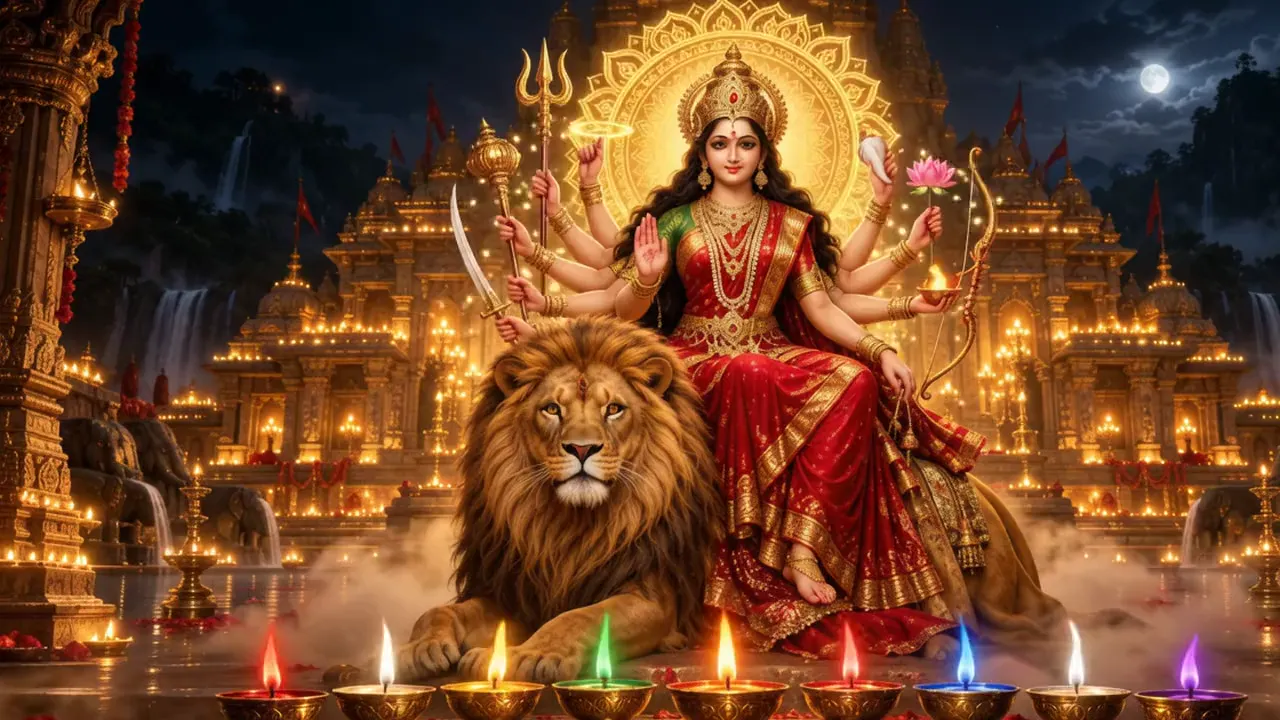
On 11 October, as the first lamps of Navratri are lit across India and around the world, let one flame burn in your home too — and step across the threshold into the nine nights of the Mother.
Begin the nine nights → ₹499The Soham meditation room on dhyanmarga.com is free for everyone, everywhere.
Free meditation room →This guide is an original composition of Dhyan Marga. Scripture quotations come from ancient public-domain texts — the Vedas, Upanishads, Durga Saptashati and Puranas — with our own translations and explanations. It is for your personal use; please share the link rather than the file.
🎵 Devi Suktam (Rigveda 10.125) — chant by Vedadhyayana Goshthi, Wikimedia Commons, licence CC BY 3.0 (faded in/out, mono).