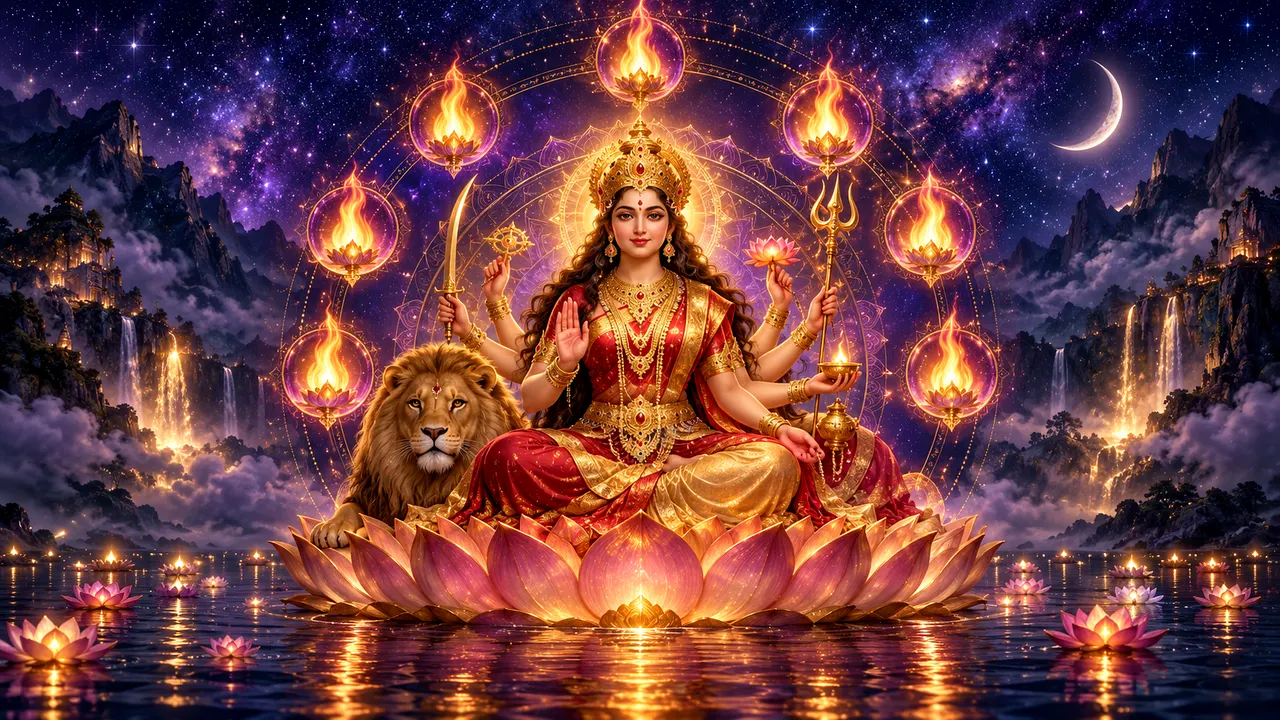
🎵 देवी सूक्तम् (ऋग्वेद 10.125) — वेदाध्ययन गोष्ठी · Devi Suktam, Rigveda

✦ From Dhyan Marga ✦
Nine nights · Nine goddesses · One intention
This Navratri, go beyond the fast — sit for 25 minutes each night with one form of the Mother, and watch how your mind changes in nine days.
🪔 Begins Sunday 11 October 2026 · Vijayadashami 20 October
Secure payment on Topmate (UPI/card, shown in your currency) · discount-code field at checkout
One-time price · opens instantly · on your phone, even offline

Ma Shailaputri is the daughter of the Himalaya — Sati of her previous life, born again as Parvati and reunited with Shiva. She rides a bull and holds a trident and a lotus. The bull is patient strength, the trident unites mind, speech and action, and the lotus is a heart that stays clean in muddy places. As the first of the nine Durgas, she is the foundation of every sadhana.
Ma Brahmacharini is Parvati as a young ascetic — barefoot, in simple white, a rosary in her right hand and a water-pot (kamandalu) in her left. She practised tapas for years to win Shiva, at last giving up even leaves, and so was called Aparna, «the leafless one». The rosary means a little practice every day; the water-pot means simplicity. Her tapas is not harshness but complete devotion fixed on one goal.
Ma Chandraghanta wears a half-moon shaped like a bell (ghanta) on her forehead — hence her name. She rides a lion and holds weapons in her ten arms, yet her face is calm. The lion is courage that is awake, the bell is the sound that drives fear away, and the moon is a cool, peaceful mind. Tradition says the ring of her bell scatters fear. Her teaching: peace inside, readiness outside.
Ma Kushmanda is the Mother whose gentle smile, the story says, created the cosmic egg (brahmanda) out of darkness. She lives within the orb of the sun and has eight arms, so she is also called Ashtabhuja; she holds a pot of nectar, a lotus, a discus and a rosary. Her green colour is growth. She teaches that creation begins not with force but with joy — even a smile can end darkness.
Ma Skandamata is the mother of Skanda (Kartikeya, also called Murugan), commander of the gods. She sits on a lotus with the child Skanda on her lap, holds lotuses in two hands, and also rides a lion. The lotus is pure love; the lion shows that this love protects when needed. Though her son leads the army of the gods, she still holds him like a little child — that motherly heart is who she is.
Ma Katyayani appeared in the hermitage of the sage Katyayana, hence her name. Formed from the radiance of all the gods, she is worshipped as Mahishasuramardini, slayer of the buffalo-demon. She rides a lion and holds the shining Chandrahasa sword and a lotus. The sword cuts laziness, delay and injustice; the lotus asks that even this be done with love and purity. In the Bhagavatam the gopis of Braj kept her vow.
Ma Kalaratri is the fiercest-looking of the nine Durgas — dark as night, hair loose, three blazing eyes, a necklace bright as lightning, riding a donkey. Yet she is called Shubhankari, «she who does only good». In the Saptashati, Brahma calls her Kalaratri, Maharatri and Moharatri. Her fearsome form frightens the devotee’s fears, never the devotee. She swallows the darkness within and leaves light behind.
Ma Mahagauri is the radiant form of Parvati that shone forth after long austerity. The story says her body had grown dusty and dark from tapas; when Shiva bathed her with Ganga water, she became bright as moonlight. She wears white, rides a white bull, holds a trident and a damaru drum, and her face is deeply peaceful. On Ashtami, her day, many homes honour young girls as the Goddess.
Ma Siddhidatri is the ninth form of the Goddess — siddhi means fulfilment, datri means giver. She sits on a lotus, her four hands holding a conch, a discus, a mace and a lotus. Siddhas, gandharvas, yakshas, gods and even asuras serve her. The story says even Shiva received the siddhis by her grace and became Ardhanarishvara. She teaches that the greatest siddhi is to offer everything to the Mother.
Tap a lamp and that night’s goddess appears in its flame. Tonight’s lamp lights by itself, counted from your Sankalp day.
Play the night’s mantra or a deep Om with one tap — the mantra changes by itself each night.
Every story, mudra, water ritual and mantra has an «Explain simply» layer — written so that even a first-time reader understands.
Eight study cards: Rigveda Devi Sukta, Kena and Devi Upanishads, Durga Saptashati, Devi Bhagavata, Saundarya Lahari, Devi Gita.
A simple version (about ₹100–150) and the full traditional vidhi (about ₹1,500–3,000) — the Mother looks at bhava, not money.
Sign your intention with your finger, tick each night, works without internet once opened, and prints as a PDF.
Each goddess’s story, her dhyana shloka (with meaning), name mantra, a line from the Saptashati, mudra, a simple water ritual, guided visualisation, seal phrase, what to avoid and a morning affirmation.
7 mantras including the Navarna mantra, «Ya Devi Sarvabhuteshu», «Sarvamangala Mangalye» and the Mahamrityunjaya — with breath, gaze, resonance and cautions. Plus a mala-counter button.
Saptashati recitation, evening aarti, sunrise–sunset lamp, Ganga-water and tulsi sprinkling, salt-and-turmeric mopping — with a shopping list and a 5-question home check.
A ✓ for each night, mantra count, one line of experience, your streak — all saved on your phone.
Choose or write your one intention and sign it with your finger — read it each night before you sit.
After the mantra, 5–10 minutes in the divine meditation room on dhyanmarga.com — a direct link inside the guide.
For thousands of years people have brought their deepest prayer to the Mother during these nine nights — a steady mind, the strength to stay with one goal, freedom from an old fear, blessings in the home, harmony in the family, movement in stuck matters, release from the weight of the past, a clear heart, and finally a trust in which peace takes the place of worry. This guide turns that one prayer into a small, sincere daily practice.
We don’t sell miracles or guarantees. We offer a path — the walking is yours, the grace is the Mother’s.
ॐ देवी शैलपुत्र्यै नमः · Om Devī Śailaputryai Namaḥ
“My roots are deep. My intention is unshakable. Ma Shailaputri is with me.”
Mudra: Prithvi mudra · Water ritual: a pinch of rock salt · Darshan: you, seated unshaken on a Himalayan peak…
Mornings that start with the phone and a rush
➜Many find mornings that begin with a lamp, a mantra and a few quiet minutes
A mind pulled in ten directions
➜A little more focus — one intention held for nine days
Fear that decides quietly in the background
➜Fear seen clearly, named, and met with one brave step
Navratri as only a fast or a celebration
➜Navratri as a living conversation with the Mother
Prayer as asking and worrying
➜Prayer as offering, effort and trust together
The scriptures describe eight great siddhis, or powers: aṇimā (becoming tiny), mahimā (becoming vast), garimā (heaviness), laghimā (lightness), prāpti (reaching anything), prākāmya (fulfilled will), īśitva (mastery) and vaśitva (control). Patanjali’s Yoga Sutras warn that such powers can become obstacles on the path. So for the seeker the teachers read them inwardly: anima is humility, mahima a heart large enough for all, garima unshakable steadiness, laghima lightness free of burdens, prapti the ability to reach others with love, prakamya a will in tune with the Divine, ishitva mastery over oneself, vashitva calm over the senses. This is the siddhi the ninth night invites you to receive.
The guide lists puja samagri two ways: a simple version with what is already in your kitchen (about ₹100–150), and the full traditional vidhi with kalash, khetri and akhand jyoti (about ₹1,500–3,000). Both are complete. The Mother looks at your bhava — your feeling — not at your money.
The Mother belongs to all her children. There is no barrier of caste, gender, religion or country in this practice — if you feel drawn to her, you are welcome. Women during their periods may follow their family tradition: many choose to practise mentally — silent mantra, darshan and seal phrase — without touching the altar, and that inner worship is complete. Elders, the unwell and the very busy can use the 7-minute version. Sincerity is the only qualification.
Instead of five separate PDFs, one designed guide: the nine nights, mantra sheet, home purification kit, tracker and sankalpa page together. Tick on your phone, read on your laptop, or make a PDF with one button and print it. Once opened, it works without internet.
Whichever night you begin is your first night. You can complete missed nights after Vijayadashami, and the guide works for every Navratri (Chaitra and Sharad).
Do the same practice before sunrise or at evening twilight. There is also a 7-minute version for busy days.
Every verse comes with a simple meaning and a roman transliteration. Feeling matters more than perfect pronunciation.
Right after payment Topmate shows both «Read Online» and «Download» links, and emails them to you.
In the «discount code» field at Topmate checkout.
No. It is a spiritual practice. For illness, a doctor’s advice is essential — the guide includes safety guidelines too.
Don’t worry. Tradition gives special weight to the last two nights — Ashtami (Ma Mahagauri) and Navami (Ma Siddhidatri). If the earlier nights were missed, honour these two with full sincerity; devotees believe the Mother accepts the bhava (heartfelt feeling) of all nine through them. If you wish, complete the missed nights one by one, in the same order, after Vijayadashami — or in the next Chaitra Navratri. Whichever night you begin is your first night. The Mother looks at the heart, not at the calendar.
There is no need for fear or guilt. Simply resume the next day — a broken mala is restrung, not thrown away. Offer a sincere apology to the Mother (kshama-prarthana). Even the recitation of the Saptashati closes with a prayer for forgiveness: «aparādha-sahasrāṇi kriyante’harniśaṃ mayā…» — thousands of mistakes are made by me day and night; see me as your own and forgive me, O Supreme Goddess. The Devi Bhagavata itself describes fasting according to one’s capacity. A fast broken by health or necessity is complete in feeling; add the missed night at the end.
This happens to many — in cities, in small families, abroad. The feeling can still be fulfilled in other ways: offer food and dakshina to a priest or a family in need; give a donation to a girls’ school or an orphanage for girls’ education; feed a cow, animals or birds — tradition holds that feeding beings pleases the Mother, who lives in all of them («yā devī sarva-bhūteṣu»); or lovingly invite the girls of your family or neighbourhood on a later day. The essence is to see the Mother in every girl and every being.
During periods, follow your family custom with an easy heart. In many traditions mental japa (silent chanting in the mind) is considered appropriate at any time — so you may practise inwardly without touching the altar: silent mantra, darshan and stillness. Inner worship is complete worship. While travelling, do the 7-minute version — it works on a train, in a car or in a hotel room. And if you are not Hindu, you are warmly welcome: the Mother does not belong to one religion or country; she is the Mother of all. Love and respect are the only requirements.
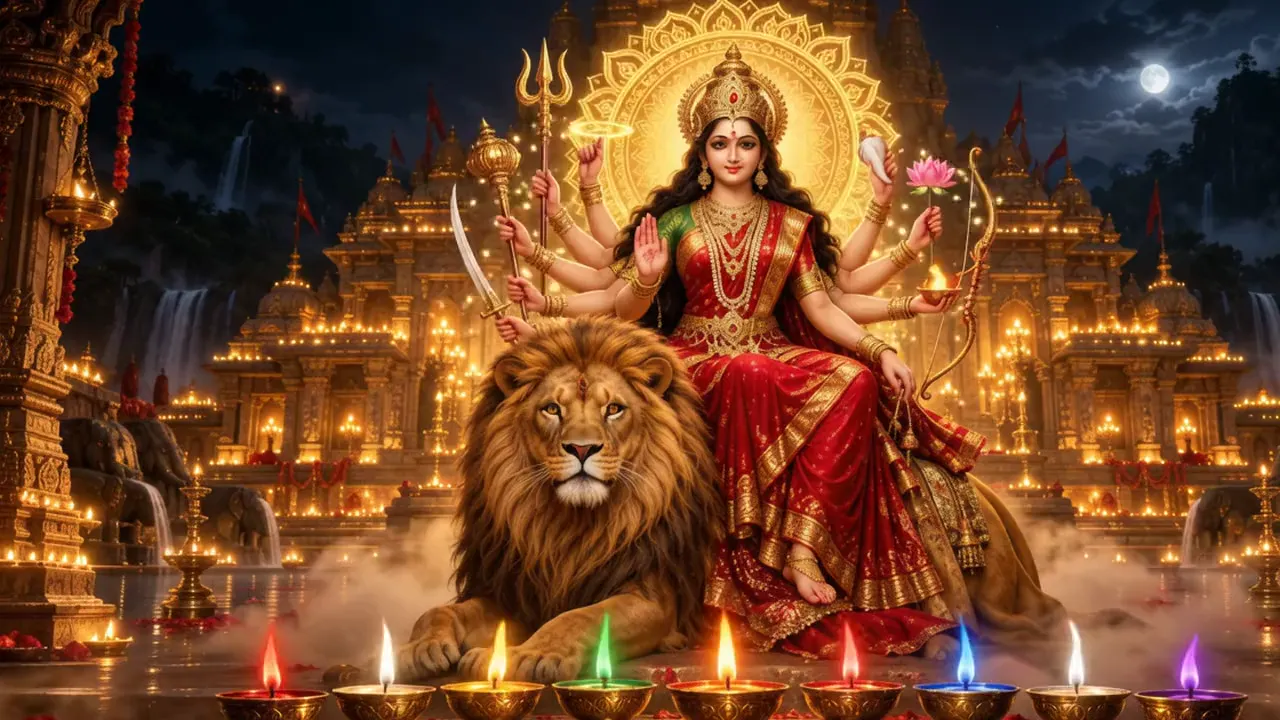
On the morning of 11 October, when the first lamp is lit — let everything be ready in your hands.
Get the guide now → ₹199The divine Soham meditation room on dhyanmarga.com is free for everyone.
Free meditation room →This guide is an original composition of Dhyan Marga. Scripture quotations come from ancient public-domain texts — the Vedas, Upanishads, Durga Saptashati and Puranas — with our own simple translations and explanations. It is for your personal use; please share the link rather than the file.
🎵 Devi Suktam (Rigveda 10.125) — chant by Vedadhyayana Goshthi, Wikimedia Commons, licence CC BY 3.0 (faded in/out, mono).